
For Mietwagen fleets with 6–50 cars
Revenue per vehicle: how many hours does each car really work?
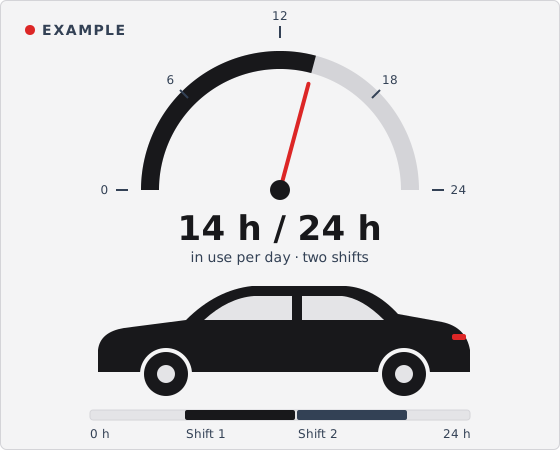
To get revenue per vehicle, add up every trip driven with one plate number across all drivers, Uber and Bolt, and divide by the hours the car was in use. Only the result after commission, wages and kilometre costs shows whether a car makes money. With one employed driver, a car stands idle at least 14 hours a day; a second shift spreads fixed costs over more hours.
- Revenue
- per plate
- Utilisation
- hours / day
- Cost
- per kilometre
- Result
- after commission
How do you calculate revenue per vehicle?
Revenue per vehicle is the sum of all fares driven with one specific plate number, regardless of who was at the wheel and which platform sent the trip. Uber and Bolt, however, report per driver. If you run 20 cars with 35 drivers, you first have to map the trips back to the cars.
Revenue per vehicle = sum of fares per plate ÷ days in use (or hours in use)
The daily figure on its own says little. A car taking $290 a day can be worse than one taking $250 if it needs twice the hours to get there. Look at three figures side by side:
- Revenue per hour in use: how well the shift is going.
- Hours in use per day: how well the car is utilised.
- Result after commission and costs: whether the car makes money.
How do you calculate vehicle utilisation?
Vehicle utilisation is the share of all available hours in which a car is in use with a driver. For a Mietwagen, the simplest measures are hours per day and hours per month.
Utilisation = hours in use ÷ available hours × 100
Hours in use are the hours in which a driver is online or on a job with that car. Breaks don't count. A car driven 8 hours a day is 33% utilised that day. If it also stands still on 8 days of the month, monthly utilisation is 176 of 720 hours, or 24%.
With an employed driver, the German Working Hours Act sets the limit: eight hours per working day, extendable to ten only if the average over six months or 24 weeks stays at eight (§ 3 ArbZG). Add a 30-minute break after six hours of work (§ 4 ArbZG) and eleven hours of rest (§ 5 ArbZG). A car only gets beyond ten hours a day with a second driver.
| Model | h / day | Days | Utilisation |
|---|---|---|---|
| 1 driver, 1 shift | 8 | 22 | 24% |
| 2 drivers alternating, 1 shift | 8 | 30 | 33% |
| 2 drivers, 2 shifts | 14 | 26 | 51% |
One driver or two shifts per car: which earns more?
Usually two shifts, because lease, insurance and other fixed costs stay the same and are spread over twice the hours. The worked example below shows the same car in both models. All figures are fictional and shown in dollars for illustration.
| Item | A: 1 driver | B: 2 shifts |
|---|---|---|
| In use (days × hours) | 176 h (22 × 8 h) | 364 h (26 × 14 h) |
| Revenue ($36 / h; shift 2: $32 / h) | $6,336 | $12,376 |
| Platform commission (example rate 25%) | −$1,584 | −$3,094 |
| Revenue after commission | $4,752 | $9,282 |
| Fuel/charging ($0.10 / km) | −$352 | −$728 |
| Maintenance and tyres ($0.05 / km) | −$176 | −$364 |
| Lease (B incl. extra kilometres) | −$550 | −$700 |
| Insurance | −$400 | −$400 |
| Other fixed (tax, cleaning) | −$120 | −$120 |
| Driver wages ($15 / h + 20% employer costs) | −$3,168 | −$6,552 |
| Result per car per month | −$14 | +$418 |
Fictional worked example, not a market average. Kilometres: 20 km per hour in use including empty trips (A 3,520 km, B 7,280 km). Commission rate and employer costs are example values. For reference, the German statutory minimum wage is EUR 13.90 gross per hour, rising to EUR 14.60 on 1 January 2027 (§ 1 MiLoV5).
| Figure | A | B |
|---|---|---|
| Revenue per day in use | $288 | $476 |
| Revenue per hour in use | $36.00 | $34.00 |
| Fixed costs per hour in use | $6.08 | $3.35 |
| Vehicle cost excl. wages per km | $0.45 | $0.32 |
| Full cost incl. wages per km | $1.35 | $1.22 |
When does the second shift pay for itself?
The second shift brings new costs: wages ($18 an hour in the example) and kilometre costs (20 km × $0.15 = $3 an hour). That is $21 an hour that has to be left after 25% commission. The shift therefore needs $28 of revenue per hour, or about $29 once the extra lease kilometres are included.
If the late shift earns less, every extra hour loses money, even though utilisation looks better on paper. That is why you need revenue per hour split by shift, not just the monthly total.
What does a Mietwagen cost per kilometre?
There is no universal figure, because lease, consumption and shift model differ for every car. Work out the cost per kilometre for each car yourself: all of the month's costs for that vehicle divided by all kilometres driven.
Cost per km = (fuel + maintenance + lease + insurance + other) ÷ kilometres
Calculate two figures: vehicle cost without wages, to compare cars with each other, and full cost with wages, to see what a trip is allowed to cost.
Three things that distort cost per kilometre
- Empty kilometres: after a job, a Mietwagen must return to its base immediately unless it received a new order before or during the trip (§ 49(4) PBefG, the Rückkehrpflicht). These kilometres cost money and earn nothing. Passing follow-up jobs quickly to the right car reduces them.
- Fixed costs in the wrong month: insurance or tyres are often paid once a year. Spread them over twelve months, or a car looks expensive one month and cheap the next.
- Downtime: workshop visits and the roadworthiness test (HU) take the car off the road. Cars carrying passengers under the PBefG need an HU every 12 months (StVZO Annex VIII, no. 2.1.2.2). On a two-shift car, that costs two shifts at once.
When does an extra car pay off, and when should one go?
An extra car only pays off once your existing cars are well utilised and you have drivers for at least one full shift. A car should go when it stays in the red for several months and better shift staffing doesn't change that.
Checklist before the next car
- Are your current cars already running two shifts, or do they stand idle in the afternoon?
- Is revenue per hour in your weakest shift above your threshold (about $29 in the example)?
- Do you have drivers with a valid P-Schein (passenger transport licence) for the new shifts?
- Is the car on your Konzession? The licence certificate lists the plate numbers of the cars in use (§ 17(1) no. 8 PBefG).
Checklist before a car goes
- Has the car been in the red after all costs for at least three months?
- Is it the shift staffing or the car itself (workshop, consumption, lease rate)?
- Are lease or insurance contracts still running that will keep costing money?
- When you stop using a car, present the licence certificate to the authority for amendment (§ 17(2) PBefG).
A Mietwagen licence (Konzession) is valid for five years at most (§ 16(4) PBefG). Plan new cars and the renewal application together.
What does the software show for each vehicle?
The software connects your Uber Fleet and Bolt Fleet accounts and assigns every trip to the car it was driven with. For each plate you see revenue, hours in use, costs and result, with no spreadsheet.
- Result per vehicleRevenue and net result per car after platform commission, monthly and per shift.
- Hours in useHow many hours each car was online with a driver each day, and which cars stand idle too long.
- Cost per kilometreFuel, workshop, lease and insurance per car, divided by the kilometres driven.
- Vendor costsInvoices from workshops, fuel stations, insurers and lessors assigned to the right plate.
- Real hourly payWhat each driver actually earns per hour, so you can spot the weak shift.
- Deadlines per carWarnings before the HU, insurance, lease end or Konzession expire and a car drops out.
How soon will you see revenue per vehicle?
In about 48 hours. This is how setup works:
Upload cars and drivers
Add plate numbers, lease rates, insurance and deadlines, plus your drivers, once.
Link Uber Fleet and Bolt Fleet
Trips, online time and revenue then arrive per car automatically.
Read the figures per car
Revenue per vehicle and driver, hours in use, cost per kilometre and upcoming deadlines.
What have other operators found this way?
Looking at the figures per vehicle, one operator found a van that was losing a few hundred euros every month. In the fleet total, it had gone unnoticed.
What does per-vehicle reporting cost?
from $5.99 per driver/month
Billing is per driver, not per car. A two-shift car with two drivers therefore costs from $11.98 a month.
FAQ: revenue and utilisation per vehicle
How do I calculate revenue per vehicle?
Add up every fare driven with one plate number in a period, across all drivers and platforms. Divide the total by the days or hours the car was in use. What matters after that is the amount left after platform commission, because only that pays for wages and vehicle costs.
How is vehicle utilisation calculated?
Utilisation is the share of available hours in which a car is in use with a driver. A car in use 14 hours a day is 58% utilised that day (14 of 24). For a monthly view, divide the month's hours in use by the calendar hours, for example 364 of 720 hours.
What does a Mietwagen cost per kilometre?
It depends on the individual car; there is no fixed figure. Divide all of a month's costs for that car by the kilometres driven, including empty kilometres back to the base. In our fictional example, vehicle costs excluding wages drop from $0.45 to $0.32 per kilometre when the same car runs two shifts.
Does a car with two drivers on shifts pay off?
Often yes, because lease, insurance and other fixed costs are spread over more hours. The second shift only pays for itself if its revenue per hour, after commission, covers the wage and the kilometre costs. In our fictional example the threshold is about $29 of revenue per hour.
How many hours a day may an employed driver work in Germany?
Working time on a working day may not exceed eight hours and may only be extended to ten if it averages eight hours over six months or 24 weeks (§ 3 ArbZG, the German Working Hours Act). Breaks of 30 or 45 minutes (§ 4 ArbZG) and eleven hours of rest (§ 5 ArbZG) come on top. A car with one employed driver therefore rarely runs more than ten hours a day.
Do empty trips back to base count in the cost per kilometre?
Yes. Under § 49(4) PBefG, the Rückkehrpflicht, a Mietwagen must return to its base immediately after a job unless it received a new order before or during the trip. Those kilometres cost fuel and wear but earn nothing, so they belong in the cost per kilometre.
When should a car leave the fleet?
When it stays in the red for several months after commission, wages and all vehicle costs, and better shift staffing doesn't change that. Remember that the plate numbers are listed in your licence certificate, and you must present it to the licensing authority for amendment when you replace or stop using a car (§ 17 PBefG).
What does the software cost for a 20-car fleet?
From $5.99 per driver per month. Billing is per driver, not per car: if your 20 cars run with 35 drivers, that is from $209.65 a month. Setup takes about 48 hours, and you can try it free for two days without a credit card.
Which car earns, which one stands idle?
We'll show you revenue, hours in use and result per vehicle using your own fleet.
- We'll get back to you this week.
- A short call about your cars, shifts and platforms.
- Setup in about 48 hours, 2-day free trial.
Send your request
Leave your details — we'll be in touch this week.